

Vladimír Kříž - Ironman
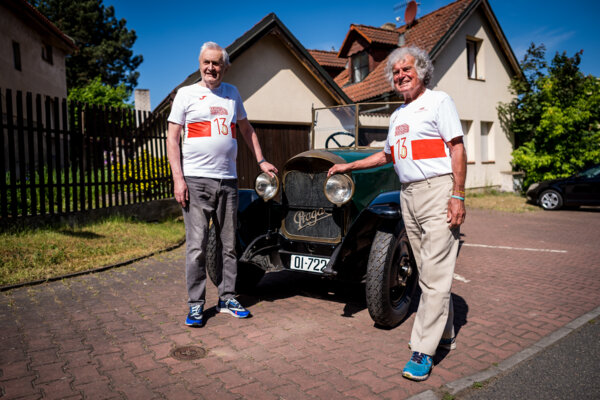
Vladimír Kříž and Miloš Šimon are symbols of loyalty and dedication to the race. They have been running Běchovice since the 1960s, and both have now recorded 61 starts. Over the decades, Běchovice has become a matter close to their hearts, and their own story has become an inseparable part of the unique tradition and history of this extraordinary race. Read the inspiring interview they gave us on the occasion of the 130th anniversary of our race.
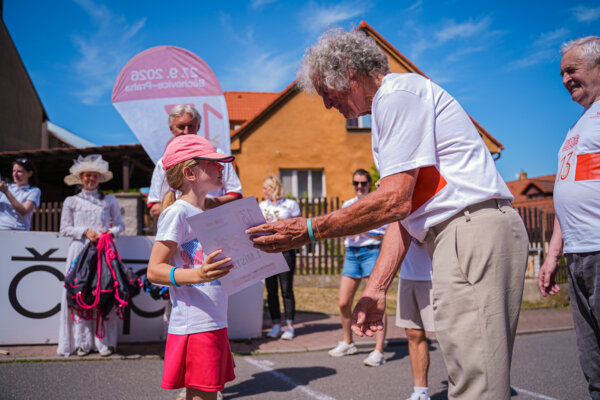
Together, they have covered 1,210 racing kilometres at Běchovice — roughly the straight-line distance from Prague to Stockholm. That is the remarkable total amassed by the race’s most loyal participants, Vladimír Kříž (born 21 December 1943) and Miloš Šimon (born 23 October 1944). Both were “hooked” on Běchovice as young men in their early twenties. Now in their eighties, they have become legends of this legendary race. (At Wednesday’s commemoration of the first edition of the race, they had the honour of holding the finish-line tape.)
Vladimír’s health no longer allows him to add to his 61 appearances, but he will still be there on the final Sunday in September. He will be watching his son and grandson, as well as his friend Miloš, who is set to draw level with him in the number of starts.
“My goal is seventy,” Šimon says with a laugh, and given his energy, there is every reason to believe that he will at least give it a try.
“I simply can’t imagine life without Běchovice,” he adds.
Together with his friend Kříž, he looked back on their first starts, the occasions when their participation was in doubt, their thoughts on the demanding Běchovice course, and what running itself means to them.
I’d Like to Run This Race 50 Times
It was around sixty years ago, but do you still remember your first Běchovice race and what brought you to the start line?
Vladimír Kříž: I was doing athletics at the time, competing in various disciplines, and I was part of a group of milers. But eventually my coach realised I didn’t have enough speed, so he told me, “You’re going to try distance running,” and sent me to Běchovice in October 1963 to give it a go. I wasn’t even twenty yet.
I immediately liked it. Suddenly I found myself in this friendly atmosphere, surrounded by loads of people who were long past their prime and were still racing. I thought to myself: if they can do it, why can’t I? And so I kept the streak going all the way until 2023.
Miloš Šimon: I was just short of my 22nd birthday when I ran it for the first time in 1966. I’d been doing athletics with Slavia since the sixth grade, a bit of everything. But I started to enjoy long-distance running, and while I was still at technical school I represented the school in a few races.
Then, in 1965, I went to watch Běchovice. I liked it so much that the following year I ran it myself. And when I stood at the finish and watched Zátopek run the race for the first and only time, that settled it for me.
So by then, the race was well and truly under your skin.
MŠ: Exactly. After that first race, a group of friends and I went for a beer in Žižkov, and I said to them in the pub, “Guys, this is such a beautiful race. I’d like to run it 50 times.”
Just imagine — you’re twenty-two, you say something like that off the cuff… and then it actually happens.
And what about you, Vladimír?
VK: I was hooked from my very first year too. But it wasn’t until the second and third races that I started thinking I had to keep the streak going and turn it into an annual tradition.
I also tried to improve and qualify for the championship category, but my best Běchovice time was around 38:20 — 38:22.4 in 1978, to be precise. I never managed to go any faster.
Vladimír, in your early days, in 1965, you actually slipped away from military service to make it to the start. What happened?
VK: Yes, my third race was a turning point. My company commander called me in. I was supposed to be discharged on Sunday, but he told me, “I’ve locked your military papers away. You’re not leaving until Monday.”
But I knew the sergeant major had the keys, so I talked him into giving me my papers and I took off. For the next fourteen days I kept expecting the military police to come and get me. But nothing happened. So thanks to that bit of audacity, I managed to keep my uninterrupted streak alive.
Miloš, was your participation ever in jeopardy?
MŠ: Fortunately never because of my health. It was more a question of other events getting in the way.
I worked for the Central Bohemian water and sewerage company, and they organised what was known as the Water Management 50, a 50-kilometre hiking event. One year it happened to fall on the same weekend. So I did the 50 kilometres on Saturday and then Běchovice on Sunday.
Another time we were on holiday in the Tatra Mountains. My son collected my race number for me, and I took the train back in the morning and rushed straight to the start.
It’s a Great Celebration of Athletics
Apart from Zátopek’s one and only appearance, is there another edition of the race that stands out in your memory for some special reason?
VK: Definitely Vlastík Zwiefelhofer’s record-breaking race in 1975, which took place in exceptionally favourable weather conditions. I have enormous respect for Vlastík, not only as a great runner but also as a person and a friend. He is an incredibly modest man.
MŠ: There was one year when they were repairing the main road in Žižkov, so the finish wasn’t in its usual place. I’d guess it was sometime in the late 1960s, maybe 1969 or 1970…
VK (interrupting): I can tell you exactly — it was 1967.
MŠ: See, I wasn’t that far off! Anyway, we ran up towards the tram line, turned right and then ran along a very narrow parallel street, with the finish in a different place.
How do you feel about the Běchovice course and its demanding profile?
VK: When I was young, I had no complaints. I was well trained and could finish comfortably. But as the years went by, certain sections became more difficult for me.
It wasn’t so much Hrdlořezák, but rather the climb up to Tábor around halfway through the race. That always took a lot out of me. And then there was the long straight alongside the tram tracks towards the finish — I really suffered there.
But that’s all part of it. You don’t remember the comfortable races. You remember the ones where you suffered — the blood, sweat and tears. That’s why I remember every marathon I’ve run, because every one of them involved suffering.
MŠ: I absolutely love the fact that there’s always music playing when you hit a rough patch near the top of Hrdlořezák. It always gives me a lift. And then, as you get closer to the finish, there are all those crowds. They squeeze every last drop out of you — you simply have to give it everything you’ve got.
You have both become part of Běchovice’s rich history yourselves. How do you see the way the race has changed over the years?
MŠ: One major change is the traffic. In the old days, buses would still be running, whereas now everything is closed off. I love seeing the crowds and the thousands of people running today. I really enjoy that. In the past, there were only hundreds of us.
VK: I see Běchovice as a great celebration of athletics, and change is simply part of life. The road has been straightened out a little and the surface has changed.
I also associate the race with some dramatic events, including, sadly, one tragic incident. I witnessed a runner collapse and, despite receiving immediate assistance, he died.
The Best Thing Is That I Got My Family Involved
There’s probably not much point asking what running means to you.
MŠ: It’s not just running. I couldn’t live without physical activity in general. I run, I cycle, I’ve been swimming with winter swimmers for forty years, and I ring church bells…
That’s another “sport”, or at least another form of physical exertion. On Sundays, we climb the tower of St Vitus Cathedral twice, and each time we ring the bells for fifteen minutes.
VK: Sport has been my whole life. From childhood until quite recently, I was always doing some kind of sport. Not only running — I’ve completed five marathons — but also skiing and cross-country ski marathons. I’ve done the Jizerská 50 several times, the Krkonošská 70, the Krušnohorská 50… and once I even dared to try a triathlon.
MŠ: I’m similar to Vláďa. I’ve run six marathons, but I’ve also completed 17 editions of the Jizerská 50 on cross-country skis and four by bike.
But the important thing is that I got my wife involved too. She’s done seven editions on skis and three by bike. She always jokes about me to our friends: “Never turn your back on Miloš. The moment you do, you’ll find a race number pinned to it and you’ll be off running some race.”
Vladimír, it must be difficult for you now that you can no longer run. Will you still be at the finish?
VK: Everything comes to an end eventually. It will hurt when I’m standing there at the start. But my son and my youngest grandson will be running. If nothing else, I’ll be there to cheer them on.
Miloš, what does Běchovice mean to you personally? What is the most special part of it?
MŠ: The best thing for me is that I got my family involved. My son has run it several times, as has my son-in-law, my twin grandsons and my granddaughter. And this year another granddaughter, who turns eighteen in the summer, is entered as well.
For the past four years, we’ve had three generations of the family running together. The only downside is that they have quite a journey to get here from South Moravia. But it really makes me happy.
What would you wish for Běchovice on its birthday?
MŠ: Another hundred years — so that generation after generation keeps doing sport.
VK: I’d like to see as many participants as possible who don’t come just to run it once for the challenge, but who keep coming back, who take the race to their hearts and become regular Běchovice runners. Just like Miloš and I have.
Thank you. Hopefully your story will inspire someone else to take part.
MŠ: I hope so. Every single new runner counts.


